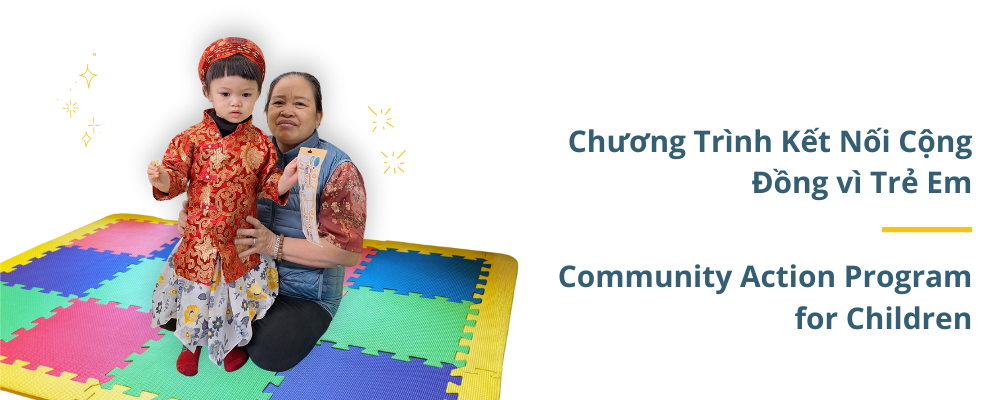
Lucy Phuong Tran is a Family Support Worker at MOSAIC, and the coordinator of the Community Action for Prenatal and Child Health Program (CAPC-HP) for Vietnamese-speaking families. In this reflection, she looks back on the Spring 2026 term and what it means to build a “village” for newcomer parents.
There are two sentences I had never heard until I became a mother in Vancouver:
“It takes a village to raise a child.”
“The days are long, but the years are short.”
I kept seeing them everywhere — in forums, in parenting groups, in articles I’d read during the short moments I could steal for myself between diapers, feeding, and the broken sleep that comes with raising a child in those first few years. Two short sentences, but they capture, in the most honest way, the demanding reality of motherhood. You don’t truly understand that journey until you live it.
My reality was this: no help, no village.
Like many newcomer mothers, I was on my own, figuring things out, carrying everything, one day at a time. And somehow, along the way, I found myself coordinating the Community Action for Prenatal and Child Health Program (CAPC-HP) at MOSAIC, trying, in my own way, to help create a village for other mothers — a place where they might have a shoulder to rely on.
What CAPC-HP Is About
At its core, CAPC-HP is designed to support parents of young children through:
- Access to trusted information
- Connection with service providers
- Opportunities to build peer support networks
But beyond services and sessions, the program is about something deeper: creating conditions where families feel less isolated, and more equipped to care for both their children and themselves, so they can learn, connect, and gradually feel less alone.
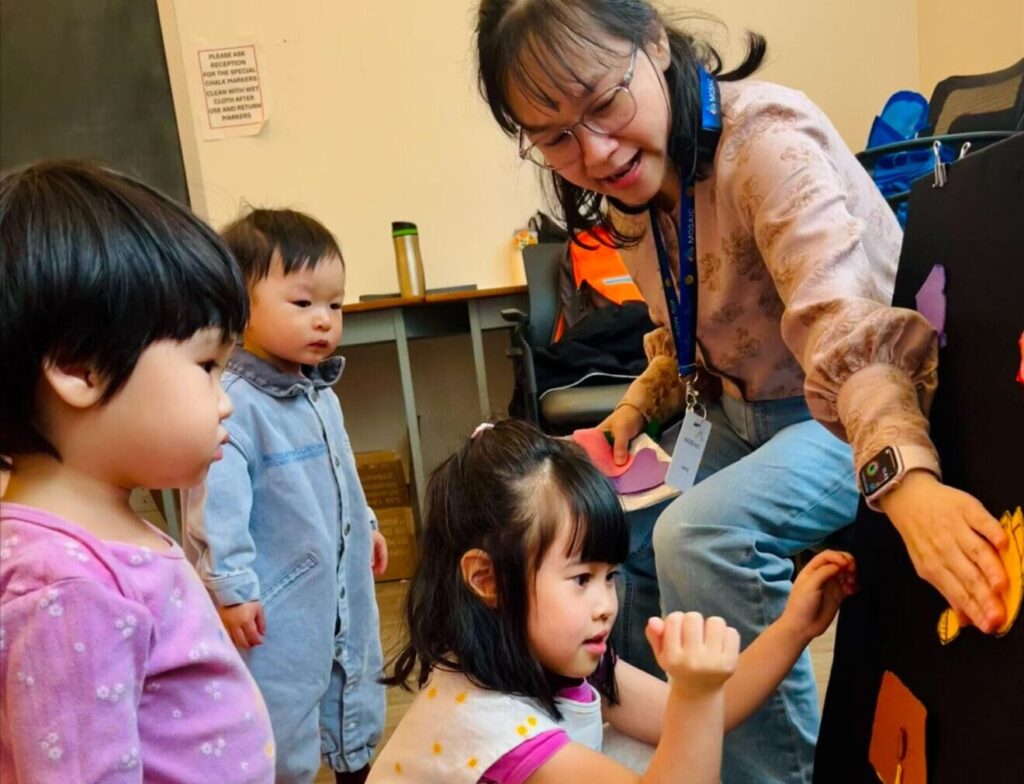
Lucy in a session with children
Inside a Session
Each CAPC-HP session runs two hours, structured into three parts.
- The first part focuses on learning and connection. Caregivers explore essential topics related to early childhood and parenting, or connect with community professionals. At the same time, children engage in free play and enjoy Art & Craft activities with the ECE teacher.
- The second part is shared mealtime. It’s a simple but meaningful moment where children practice social interaction, while caregivers have the chance to sit together, talk, and build connections.
- The third part is Circle Time—often the most anticipated part of the session. Children and caregivers come together to learn and play side by side, guided by the ECE teacher in a space filled with joy, rhythm, and connection.
This term, for the first time, I felt proud that the program had a clear structure from start to finish, consistent communication through social media, and stronger participant engagement than we’d seen before.
Across the 11 sessions this past spring term, I’ve had the opportunity to cover topics that are practical and relevant for families:
- Childcare resources (Westcoast Child Care Resource Centre)
- Kindergarten registration (Vancouver School Board)
- RESP and financial literacy for families (a topic I am especially passionate about)
They may not seem like big things, but they’re the kind of information families truly need: timely, accessible, and connected to their everyday lives.
Interested in joining?
The CAPC-HP program is open for Fall term registration!
Guest Speakers and Service Access
In spring term, we partnered with a range of service providers to bring expertise directly into the program:
- Multicultural Victim Services
- Public Health Nurse
- Dental Hygienist
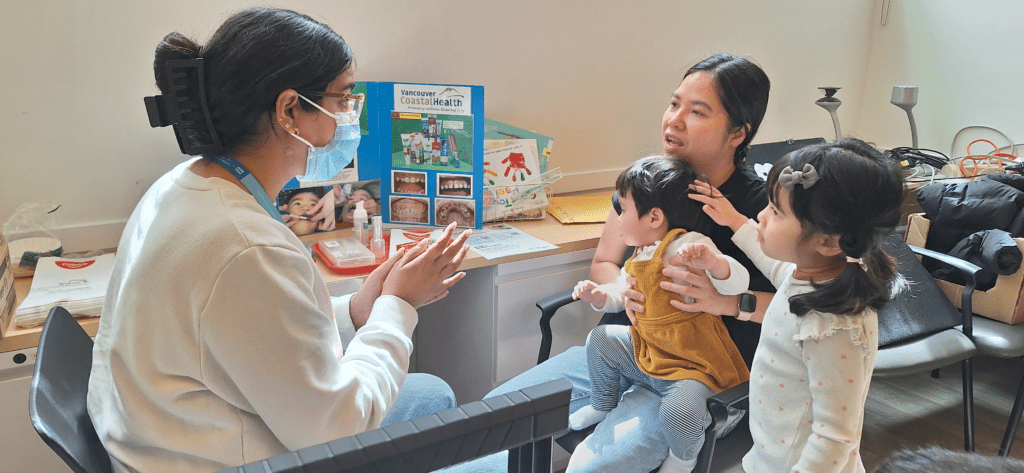
Dental Hygienist session
These sessions gave participants a chance to ask questions in a supportive environment, better understand available services, and build confidence navigating systems they might otherwise face alone.
Connection Beyond the Classroom
In addition to formal sessions, we kept connected in two ways: an official Facebook group for updates, and a client-created WhatsApp group for daily conversation. Both offered a space to stay in touch, but the WhatsApp group became the most active space for real connection.
Through small, consistent exchanges, sharing updates, asking questions, supporting one another, participants built trust and a sense of belonging that carried beyond our two hours together each week.
Learning all the time can be exhausting, though, so outings like our Science World field trip became a much-needed break, a win for both parents and children. Children got to explore and play, while parents had a moment to pause, talk, and breathe. These informal settings created space for stress relief, peer bonding, and the kind of organic conversation that builds real connection.
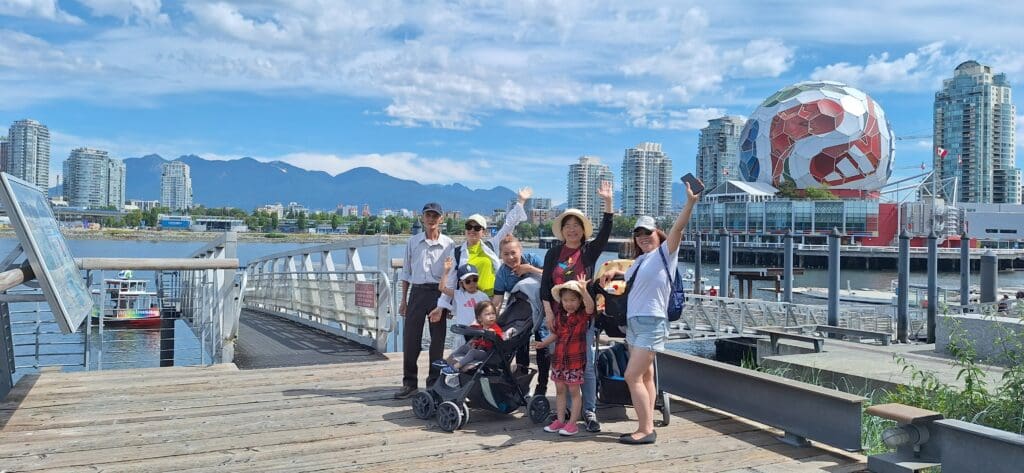
Graville Island field trip
 What Families Told Us
CAPC-HP is a government-supported program, and we’re required to measure outcomes, not only through feelings, but through real impact. Sometimes that impact shows up in the simplest words. Participants told us:
“I wish there were two sessions per week.”
“I feel safe here.”
“I learned things I actually need.”
These responses indicate that the program is not only delivering information,
but also creating a trusted and supportive environment.
What This Means
As a frontline staff member, delivering CAPC-HP isn’t just about running a program. It’s about responding to a real and lived need. Many of the families we work with are navigating parenthood while also adapting to a new country, new systems, and limited support networks.
CAPC-HP becomes one way to bridge the gap between need and access, between isolation and connection. We may not be able to fully recreate a traditional village, but through consistent effort, we can build a functional version of one, grounded in real experience.
See You in the Fall
The program pauses for summer, and the Fall term resumes in September. To kick off the Fall season, we will also be hosting a Breast & Cervical Cancer Screening Workshop in Vietnamese on August 14, in partnership with BC Cancer.
For many families, the starting point is no help, no village. If, through this program, even one family can find a small place to lean on, then “it takes a village” is no longer just a sentence. There is still so much to build, and it takes many hands to build it.
Let’s keep building it, together.
Lucy Phuong Tran
Family Support Worker, ECEA and mother of a 4-year-old
(This reflection was first published on Lucy’s Substack and is shared here with permission and light edits. The original post is also available in Vietnamese.)